
At the IBM Executive Roundtable during the AI Summit in Singapore (ATxEnterprise), one conviction stood out: the real challenge of AI in the enterprise is not only technological.
The theme of the roundtable was clear: "Powering AI at Enterprise Scale: Turning Fragmented Systems into Intelligent Foundations." Today, many companies are launching AI projects. Prototypes, copilots, automations, internal pilots. But many of them fail before they ever reach real production.
What struck me is that the failure does not always come from the technology itself. IBM presented the infrastructures, servers and architectures designed to support AI at enterprise scale, and on that side I genuinely believe the hardware and software will be there. The servers will follow. The models will keep improving. The tools will become more and more powerful.
“When technology moves this fast, one question remains: how can humans keep up?”
The poll that said it plainly
During the session, a live poll was shared with the room: what is the biggest reason organizations' AI pilots fail to scale? The answer was clear. Not budget. Not hardware. Not access to technology.
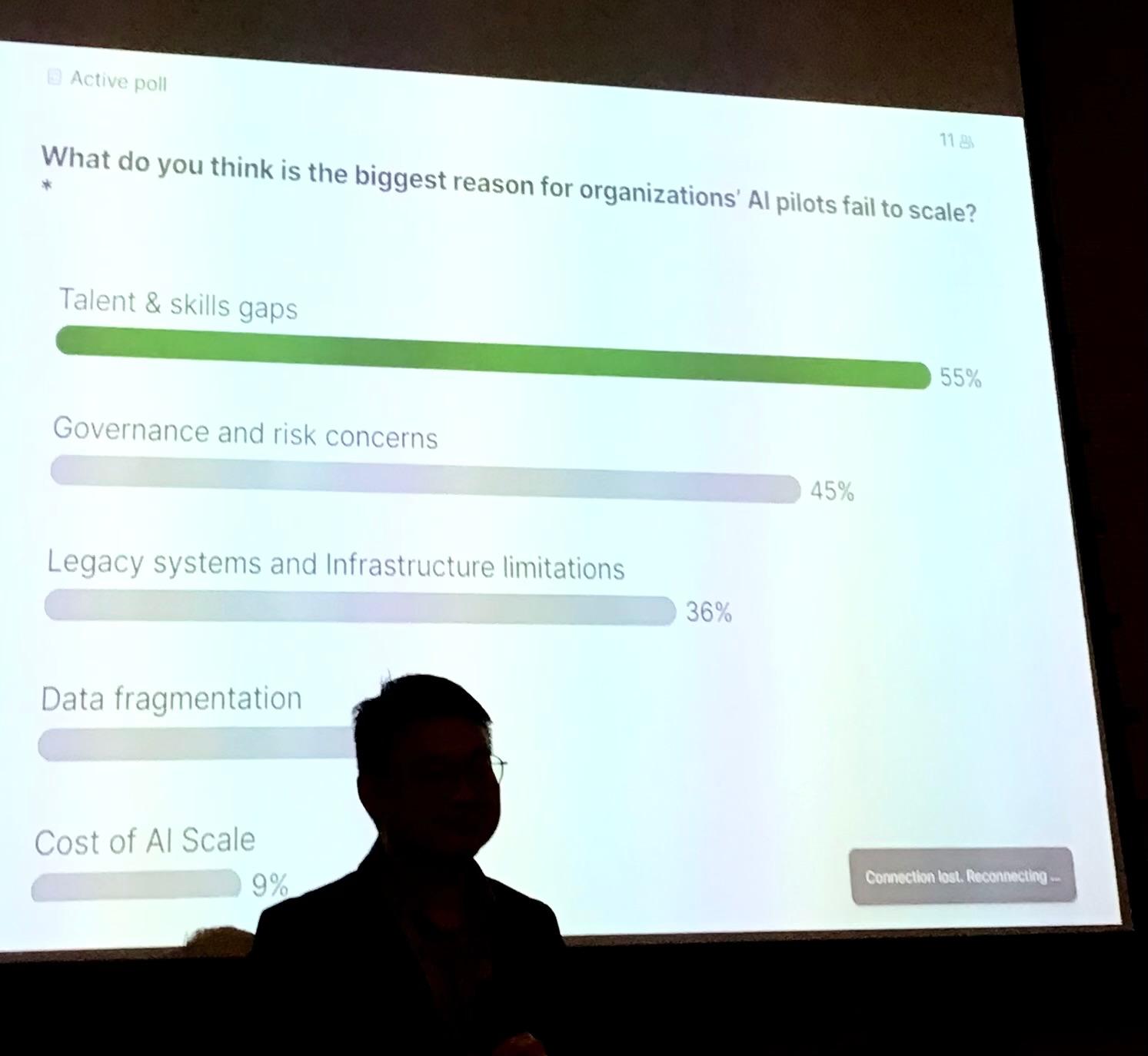
Talent and skills gaps came first, at 55%, ahead of governance, legacy systems and cost. The number one barrier to scaling AI was human.
Where humans still make the difference
I believe technical AI skills will become more and more accessible. Understanding AI, using the right tools, prompting, analyzing, automating: all of it will become easier and more democratized. Today, with AI, everyone can learn faster. In many areas, AI can even be more expert than an expert.
So maybe the question is no longer "How do we compete with AI?" The real question is: where can humans still make the difference? For me, the answer is simple. In our ability to be human.
“The real challenge is not to connect systems. It is to connect people.”
As a product manager, I see it every day. The real challenge is not only to connect systems. It is to connect people: business teams, developers, designers, stakeholders, different departments, users. Each team has its own goals, language, constraints and priorities. Very often, the real problem does not belong to one team. It is a shared problem that requires listening, structure and a common understanding.
To lead a successful AI project, the most important skills may be listening, empathy, leadership, the ability to align teams, and the ability to make clear decisions based on facts, data and a shared objective. Without ego. Without hiding behind technology. Without using AI as a solution for a problem we have not truly understood.
“Sometimes the problem is not technical. It is human.”
Because before asking AI to solve a problem, we first need to understand the real problem. And sometimes, that problem is not technical. It is human.
The question I am left with
There were many other challenges discussed: data readiness, governance, security, fragmented systems, enterprise-scale adoption. I will come back to those in a future piece. But for now, my main question is this: how do we train humans to be more human, in a world where AI is becoming more and more powerful? And maybe even more importantly: can AI help us develop these human skills, or is it still the role of humans to train humans?
Thank you to IBM for the invitation to this Executive Roundtable.
Eric.